Herewith I will make an effort to demonstrate the common appearance of root *k̑er- in PIE. I will take derivatives from each “separate” root and show that they have strong semantic connection.
*k̑er-(1) - horn, head, upper part of body.The horn has noticeable C-shape, which is first semantic feature. And it grows from the head, which is also important.
 Carat
– unit of mass, used for measuring gemstones and pearls. Initially comes from “carob” with meaning “small horn” due to noticeable C-shape of carob tree beans. Horned shape.
 Carrot
– vegetable with noticeable horned shape.
 Carotid
– artery, which comes into the head and has special “horned” Y-shape when splitted.
 Cerastes
– kind of snake with horns on the head.
 Ceratopsian
– horned dino.
 Cerebellum
– part of the brain. Related to the root as it is in the head.
Cerebrum – brain itself.
Cervine – horned animal.
Cervix – applied to neck-like parts of the body. The neck is related to the head.
Cheer – stands for the face, which is on the head.
Chelicera – horn-shaped mouth parts of some arachnids, crabs and spiders. Sometimes looking like a horn/knife, sometimes like scissors.
 Corn
– horn-shaped vegetable.
 Cornea
– C-shaped part of an eye. Possible related as a part of head.
 Corneous
- a biological and medical term meaning horny. Used to name something having horny shape of horny origin. For example hooves.
Corner – angle. V-shape, which is geometric semblance of C-shape.
 Cornet
– music instrument with horn-like conical pipe as semantic feature. Or horned shape wafer cone.
Cornculate - small horn-shaped processes.
Cornification – conversion of body cells into hard horny structures (hair, nails, feathers)
Cornu - a structure with a shape likened to a horn.
Corydalis – horn-shaped type of flower.
 Corymb
– special type of flower heading. Gives horn/crescent shaped flower.
 Coryphaeus
– Leader of chorus. Head in figurative meaning.
Cranium – skull. Head.
Criosphinx – Sphinx with horned ram’s head.
Hart – Male type of deer. Horned animal. In most cases, female deer does not have horns.
Hartebeest – horned animal
Hornbeam – type of tree with horn-shaped flowers.
 Hornblende
– horned-shape mineral in igneous rock.
 Hornet
– insect with horn-shaped body.
 Hornfels
- is called so because of its exceptional toughness and texture both reminiscent of animal horns.
Longicorn – horned beetle.
 Migraine
– headache.
Olecranon – elbow head. Horned shape part of bone. Stays in a corner formed by bones of the hand.
 Rhinoceros
– Animal with a horn.
Saveloy – rod or C-shaped sausage.
 Serval
– wild-cat with noticeable “horns” of ears.
 Tarboosh
– “horn” like cap.
 Triceratops
– horned dino.
As we can see, the semantic core is turning around main given concepts of horns and head.
Have also to point attention on such objects as Latin “
caravel” – type of boat, coming from Greek “
karabos” with meaning
beetle,
lobster (due to shape of its pincers) . Any boat has recognizable C-shape silhouette. As for caravel it was made from cow leather, so this semantic feature may play more initial role. Russian “
korova” (cow) also comes from discussed root.

This pagan god name is HORS. He is coming on a boat and rules by horned animals. But in etymology, there is no connection to *ker- root...
At the same time there is a word in Russian – “
horn”, which means bugle. This construction is simple horn and 100% should be related to PIE root
*k̑er- (1), but if you will look in the dictionary it will be said that it comes from Latin fornacem (oven) and then from PIE root
*gwher- "warm". Where is the logic?
Or English “
crown”. It is related to the head, has horns, sounds same as “horn”, but is not connected with above root!
Or “
crab”? “Karabos” with meaning “lobster” goes to *k̑er- (1), but “crab”, which has pincers same as lobster goes to
*gerbh-? Come on guys! It is not falsifiability. It is bullshit, that nobody wants to question.
Now let’s take a look at second root:
*k̑er-(2) – to grow, increase.Most derivated words demonstrate the process of growing, enlarging.
Accrete, accrue, concrescence, increase. But there are some, where this process is not seen clearly and transferred mostly metaphorically.
Crescent – growing, increasing moon. At the same time, it visually looks like a horn.
 Crescendo
– swelling volume of sound. Yes, there is a process of growing of volume, but look at the symbol for crescendo. It is an angle. One who made it understood which growing object symbolize the process. It is growing crescent, which geometry can be transferred as angle, corner symbol.
 Cereal
– again growing? Yes, the grain grows, and bread paste “grows” while being prepared, but with same logic everything around us is growing, including horns and heads ) Just take a look at any grain. Its has more logic semantic feature. It looks like small horns or crescents.
 Ceres
– goddess who gave a name to previous Cereal. It is the goddess of agriculture. Then look at her image. It is logically pictured with one of main tool for cutting the grain – the sickle. And it has crescent shape! By the way the sickle is called "Serp" in Russian, but with no relation to discussed root...
 Concrete
– it is not growing, but it is hardening. In figurative sense it is close. But if we take lunar paradigm, then everything becomes more easy. Growing crescent finally gives the full moon, which looks like a hard stone (an actually is). Also we remember that any conctere is made from stones.
Crew – initially group of soldiers. Where is growing? Here it is. Soldeirs are youngest and lowest rank in army. Afterwards they will grow to mayors and generals. So it is logic to call them “growing”. Next word demonstrates same more precisely.
Recruit – youngest rank in army.
Griot – poet, bard, musician. Try to find the process of grow here? May be it was the lowest rank of people. But I think, the explanation is simple. Main tool of such people is their mouth, which looks like a white crescent. Remember Coryphaeus?
 Hypocorism
– Oops. Completely opposite process the grow. It is shortening of long name in most cases. Hard to explain if you don’t understand lunar hypothesis. The moon is not only growing, but also decreases. Becomes small and short. So in this case no break of logic.
Kore – Means “maiden”, but connected to crescent. Why? Because “maiden” means virgin, pure, clean. And young moon in figurative sense is clean, virgin, young. Same with
“kouros” with meaning boy, son.
Which story is about young boy and God’s son? Yes, the Bible. As it is an allegoric story about visible characteristics of the moon.
Sincere – pure, honest, heartfelt, soulful, frank, candid. Recognize somebody? Usually people say it about the god. And it is correct, as they talk not about something fictional, but about an object they can see with their own eyes – the moon.
So you can see second “unrelated” root *k̑er-, when checked deeply, gives understanding, that the process of growing, increasing was taken from the environment, by observing such process happening with the moon. That is why *k̑er- (1) and *k̑er- (2) are completely same root. The geometry of crescent is nothing but the geometry of horn. Both growing and both heading the society.
That is why Moses is pictured with horns on his head, Jews where praying to “golden calf” etc.
 Moses
is phonetic analogue of Russian
Mesyac, that means CRESCENT!!! Coincidence? No! Forgotten history of humanity.
So now I have a question. Why word “grain” does not come from same root as “cereal” as it means completely same? Why word “grow” comes from another root? Why "corn" is separate root? It is also the cereal. Why "chorus" goes to PIE *gher-? There tons of such mistakes in etymology that linguists accept without any check, and make more mistakes, building further theories based on such delusions.
Let’s fix it together!
Anyone wants to become next Vasmer or Pokorny? I give you this tool for free. Use it. Open the eyes of society!
Alright, there are 2 more *k̑er-s. Let’s dissect them.
*k̑er- (3) – string, plateUnconnected from first sight they become connected if you know what is all about. It is easy.
String is the allegory of new moon – youngest crescent coming in form of string, thin line.
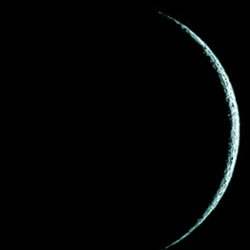
The plate has also same silhouette from one view – the crescent.

Moreover, it has full round silhouette from another view, which is graphic allegory of full moon. That is why the plate and the cup are so spread symbol in religions. They root to initial object that was considered by ancient people as a god.
I did not find reflexes, but I predict that above described logic will be followed in their cases.
And finnaly:
*k̑er- (4) - to harm, injure; ruined, spoiledAgain, no connection from the first sight. It can be called unrelated in deed, but there is a logic.
The moon in its last phase becomes harmed. Russians directly call it "harmed moon". In English we use waning moon, which means old, weakening. The process is opposite to grow, but we have seen such phenomena in case of “Hypocorism”.
I understand that some old linguists did not find such logic (or did not want to find), but in time of democracy and science how you - professionals - don’t see such simple correlation?
All 4 *k̑er- are the same root, divided (may be politically) into four, not to let people understand real roots of the language, religion etc.
I ask again for you help! There are so many such mistakes in etymology. Lets fix it! Lets explain to society where did we take initial roots. What was the role of our satellite in this process!
Earthlings speak moon language! The binary nature of this unique object gave us ability to develop binary logic. We made a computers on this logic, but still don’t understand that our own logic is same. Operating by crescents and circles, we made letters, words, knowledge. That is why old Hindu wisdom says: “
Knowledge is milk flowing down from celestial cow”. Stupid mistake is to forget about this simple concept and start fighting between “solar” and “lunar” religions.
They are all lunar. Let’s stop this f@cking bloodshed!
Sorry for long speech and emotions. Believe you understand me.
